
The Quiet Weight Nursing Leaders Carry (And Rarely Say Out Loud)
3/1/20262 min read

My post content
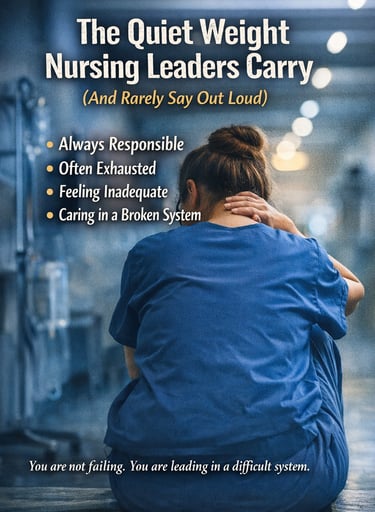
The Quiet Weight Nursing Leaders Carry (And Rarely Say Out Loud)
There’s a pain many nursing leaders feel—but rarely name.
It’s not just workload.
It’s not just staffing.
It’s not just compliance, budgets, or being “short again.”
It’s the quiet weight of responsibility that never really shuts off.
Nursing leaders are expected to hold everything at once: patient safety, staff morale, regulatory requirements, emotional crises, ethical dilemmas, and the well-being of teams who are themselves exhausted. You are asked to be decisive and compassionate, strategic and available, confident and endlessly patient—all at the same time.
And when something goes wrong, the assumption is often silent but clear: you should have prevented it.
The Pain Beneath the Role
One of the deepest pains in nursing leadership is the feeling that you are never doing enough—no matter how much you give.
You stay late.
You fill gaps.
You absorb stress so your team doesn’t have to.
You advocate upward and protect downward.
Yet many nurse leaders quietly carry guilt:
Guilt for not being present enough
Guilt for saying no
Guilt for holding boundaries
Guilt for not being able to “fix” broken systems
Research consistently shows that this emotional burden is not unique or imagined. Studies on healthcare leader and clinician burnout demonstrate that chronic emotional exhaustion, moral distress, and role overload are strongly linked to leadership roles in complex healthcare systems (Shanafelt et al., New England Journal of Medicine). In fact, this landmark article on burnout and the emotional burden of healthcare leadership
highlights how systemic pressures—not personal weakness—drive burnout among healthcare professionals and leaders.
This isn’t a personal failure.
It’s a systems issue—but it’s felt personally.
Leading in the Space Between Care and Constraint
Nursing leadership often lives in the space between what you know is right and what you’re allowed to do.
You see the impact of burnout before the metrics catch up.
You recognize unsafe patterns before they become reportable events.
You hear the emotional exhaustion in your staff long before it turns into turnover.
And yet, you’re frequently constrained by staffing ratios, financial realities, policies written far from the bedside, and decisions that don’t reflect clinical reality.
That tension—between care and constraint—is exhausting.
Why This Pain Goes Unspoken
Nursing leaders are often promoted because they are strong, reliable, and capable. Over time, that strength becomes a mask.
There’s little space to say:
I’m tired.
I don’t have the answers.
This is heavier than I expected.
So the pain becomes normalized.
Silenced.
Internalized.
And that silence is costly.
What Nursing Leaders Actually Need
Nursing leaders don’t need more resilience training that tells them to “bounce back.”
They don’t need platitudes.
They don’t need to be reminded how strong they are.
They need:
Spaces where complexity is acknowledged
Leadership development that reflects real clinical environments
Permission to lead as humans, not machines
Strategies that prioritize sustainability—not just survival
Most of all, they need to hear this truth:
You are not failing. You are leading in an incredibly difficult system.
Why This Conversation Matters at Our Leadership Conference
This leadership conference exists because naming the pain is the first step toward changing how we lead.
We believe nursing leadership deserves:
Language for what you’re experiencing
Tools that respect clinical reality
Community that understands the weight you carry
A vision of leadership that includes care for the leader—not just the led
Because when nursing leaders are supported, teams stabilize.
When teams stabilize, patient care improves.
And when leaders are allowed to lead sustainably, healthcare becomes healthier—for everyone.
You are not alone in this.
And you don’t have to carry it quietly anymore.
Contact
admin@elevateleadersconference.com
Elevate Leaders© 2025. All rights reserved.